
Summary: The best places to buy rental property in Ohio for cash flow, especially using the rent-by-the-room student housing strategy, are Cleveland, Cincinnati, Columbus, and Athens.
Ohio’s low median home prices (many cities under $200K) combined with strong rental income make it one of the most profitable states. Below, I break down the rental rates, vacancy rates, job growth, and population trends for each city, plus real deal case studies, so you can choose the right market and strategy for your first (or next) Ohio rental property.
What are the best places to buy rental property in Ohio?
You’re in the right place.
Today, you’ll learn how to find highly profitable investment properties in Ohio, and specifically, how I use a rent-by-the-room student housing strategy to get some of the highest cash flow in my entire portfolio.
I share insights based on my own experience (I own about 62 rental rooms across Ohio, built up over the last few years), as well as market data.
Want to learn more? Read on!
The best cities in Ohio to invest in real estate are:
- Cleveland: Top student housing market, anchored by Case Western Reserve University and Cleveland Clinic
- Cincinnati: Great universities, strong demand near Xavier and University of Cincinnati
- Columbus: Booming economy, diverse job market, and great student population
- Athens: Small college town with steady student demand near Ohio University, plus one of the lowest costs of entry on this list
To learn why and how to choose the best location for yourself, read on…
Table of contents:
What are the best places to buy rental property in Ohio?
Choosing the right place to invest in is one of the most important decisions you’ll make as a real estate investor. That decision alone can increase your return by 10x in the long-term.
That’s why you should research these six things when searching for your first rental property in Ohio:
-
Average rental rates: Knowing the average rents in the city (and different neighborhoods) is essential for calculating your return on investment (ROI). You want your rent prices to be competitive but still yield a profit.
-
Median property values: Your rental income needs to cover the mortgage, plus profit, for your real estate business to succeed.
-
Vacancy rates: The number of vacant properties in the city will show you how the rental market is doing.
-
Job growth: High employment growth in the city means more job seekers looking for places to rent.
-
Median household income: Investing in a place with a high median household income means you can charge higher rents.
-
Population migration trends: This one’s simple but non-negotiable for me. If people are moving out of a state or city, that’s an automatic red flag, regardless of how good the numbers look otherwise. Declining population means shrinking demand, lower rents, and a harder time filling vacancies down the road.
If you take the time to research locations in Ohio, you could find some very lucrative opportunities. My Ohio rentals are some of my best performing properties, so I personally know the Ohio rental market can be very profitable.
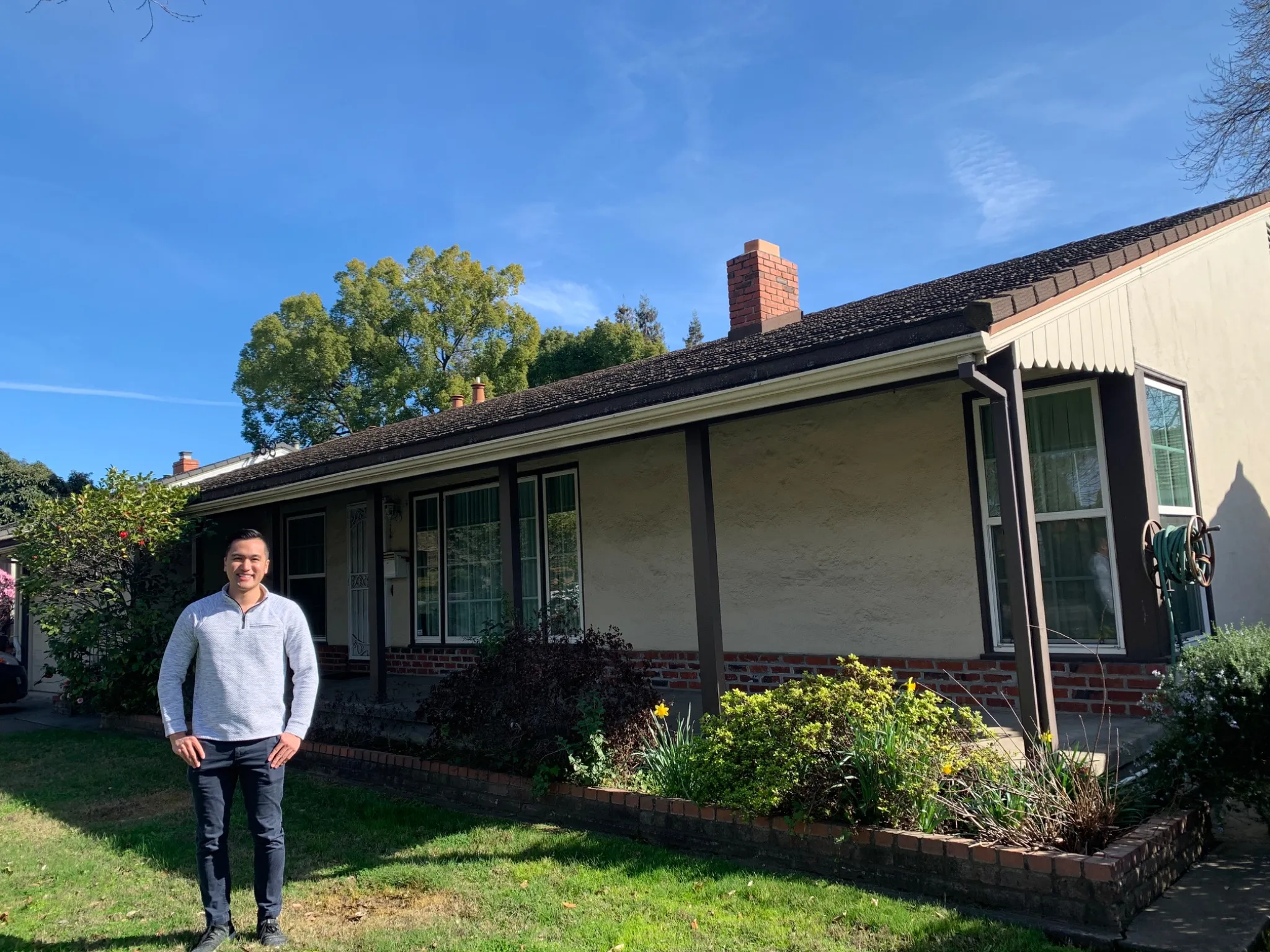
Here I am in front of one of my properties
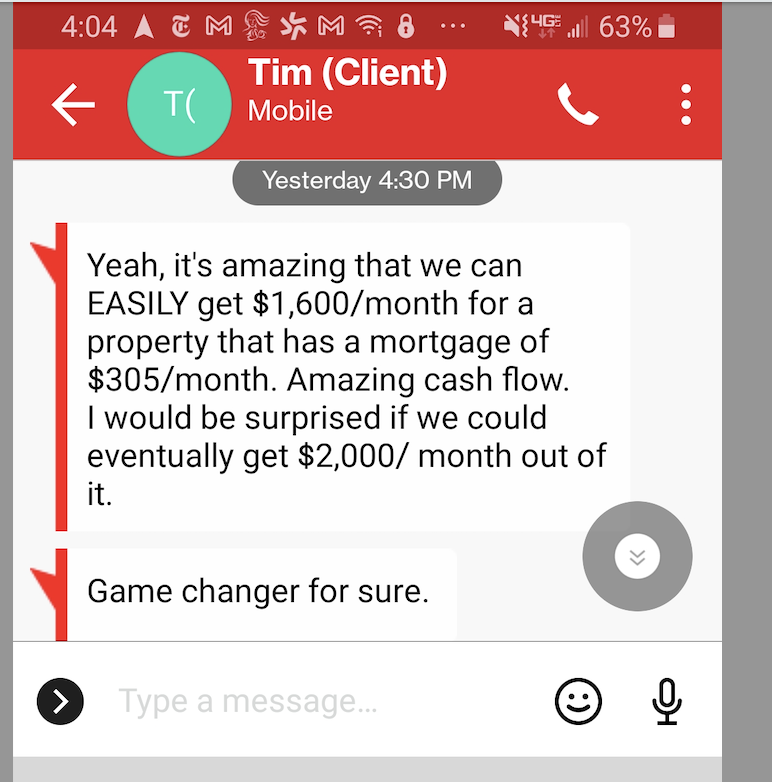
Similarly, many of my consulting clients have found great deals in Ohio. Take Tim, who bought a property for $62,000 and now has $1,600 in monthly cash flow.
However, your success will depend on the rental property strategy you use.
I invest in rent-by-the-room student housing properties. This is the most profitable rental strategy for beginners, especially those in busy 9-5 jobs who don’t have time to become full-time property managers or spend all their time on fixing tenant issues.
I rent the properties by the room to students and healthcare workers instead of renting the entire property to one tenant. Further down, I explain what the strategy is all about and why it is so profitable.
For now, I’ve listed the locations based on this strategy. In other words, these locations are great college towns in Ohio to invest in.
Keep in mind that if you choose to invest in student housing, there’s a seventh thing you need to check before you buy anything: unrelated-tenant occupancy ordinances.
Every city has its own rules about how many unrelated people can legally live together in a single-family home, and these ordinances vary block by block in some cases.
Skip this step, and you could end up with a house full of students you’re legally required to kick out because a neighbor complained. I always recommend pulling up the city’s zoning map and confirming before making an offer.
To help you get started, I used my own experience and the following sources to put together this list.
With that, let’s dive into the best places to buy rental property in Ohio.
1. Cleveland
Cleveland is an excellent market, and it’s where the bulk of my 62 rooms are located. If you’re going to focus on just one Ohio city for a rent-by-the-room student housing strategy, this one can work out very well.
The reason comes down to Case Western Reserve University and Cleveland Clinic. Between the two, you get a steady pipeline of graduate students, medical residents, and healthcare professionals looking to rent. In my experience, these tenants tend to be quieter, more reliable, and willing to pay a premium for a well-located house.
Where to buy (and where not to)
Two neighborhoods I actively target are Cleveland Heights and Little Italy. Beyond just being safe, well-kept areas, simply telling a prospective tenant (or their parents, if you’re renting to undergrads) that the house is in one of these neighborhoods builds instant trust.
On the flip side, stay away from East Cleveland. I’ve talked to local realtors and looked at the data, and it’s consistently one of the more rundown, higher-risk parts of the city. It might look tempting based on price, but it’s not worth the headache.
The tax drag you need to underwrite
Cleveland’s property taxes are high, hovering around 2.3%. That cost eats into your cash flow, so always build it into your underwriting.
Case study: My Ashbury house
To show you what a good deal looks like here, take my Ashbury property. I bought it at an $80,000 discount after it sat on the market for 60 days. This property is projected to net $3,700 a month in cash flow. It had some potential orange flags, but the fundamentals (location, proximity to campus, and room count) made it worth the extra work.
The property I regret buying
I bought a property that was too far from campus, which immediately hurt demand. On top of that, the kitchen was way too small for the seven-bedroom student conversion I had planned, and parking was a nightmare: only one spot on the property, no street parking allowed, and tenants had to pay $125 a quarter just to park off-site.
Between the location, the kitchen, and the parking situation, it checked almost every box for what not to buy. If I’d walked the neighborhood and thought through the day-to-day tenant experience before making an offer, I would’ve passed.
- Median rental price: $1,249
- Median property value: $116,759
- Vacancy rate: 8.72%
- Job growth: Roughly flat, with the metro adding only about 800 net jobs in 2025
- Median household income: $43,383
- Population trend: Two consecutive years of marginal growth, though the city is still down about 6,474 residents compared to 2020
2. Cincinnati
Cincinnati is another market where I’ve seen strong results with the room-by-room strategy, but it takes more precision than Cleveland does.
Xavier University
A lot of investors make the mistake of buying as close to Xavier as possible, assuming proximity always wins. In my experience, that’s not the smartest play here.
I’d rather push a bit further east toward Hyde Park. It’s a safer, higher-demand submarket, and it consistently draws stronger interest from students and their parents than the streets immediately surrounding campus. You’ll pay a bit more, but the lower turnover and stronger tenant pool make up for it.
University of Cincinnati
For UC specifically, I use a simple but effective vetting process: pull up a map of the university, draw a one-mile radius around campus, and then cross-reference that radius against what students are actually saying in local forums (Reddit, Facebook groups, and campus housing pages).
You’re looking for the overlap between “close enough to campus” and “neighborhoods students actually want to live in.”
One risk: Old housing
Cincinnati has a lot of old housing stock, and some of it is falling apart. This city requires on-site due diligence. Once you’ve narrowed down a neighborhood, walk the house carefully (or send someone who will) and budget for the fact that older Cincinnati homes often need more work than they let on at first glance.
- Median rental price: $1,427
- Median property value: $251.326
- Vacancy rate: 7.72%
- Job growth: Cincinnati is on track to add roughly 5,000 jobs in 2026, marking its sixth consecutive year of growth
- Median household income: $56.910
- Population trend: Steady growth; up about 5,311 residents since 2020
3. Columbus
Columbus is a solid option in Ohio. The city has scenic, upscale neighborhoods that keep drawing people in, backed by a genuinely diverse job market. Intel’s ongoing investment around Columbus continues to bring in high-income jobs.
For student housing specifically, Ohio State University drives real demand here. I know several landlords who run multiple student rentals in this market.
- Median rental price: $1,500
- Median property value: $248,686
- Vacancy rate: 7.72%
- Job growth: Positive and outpacing the national average, driven by steady tech-sector investment (source)
- Median household income: $67,084
- Population trend: One of the strongest in the country — Columbus added more than 21,000 residents in 2025, roughly double the national growth rate
4. Athens
Athens is a smaller market than the other three on this list. It’s home to Ohio University, a large school with a steady stream of student renters every year. Because it’s a smaller, more contained college town, demand here is heavily tied to the academic calendar.
The HOA quirk you need to know about
A quirk I’ve noticed in this city is that a lot of properties in Athens, especially those closer to campus, carry an unusual yearly Homeowners Association (HOA) fee. It’s not something you typically expect on a single-family rental. Before you make an offer here, always check whether the property carries one of these fees and factor it directly into your numbers.
- Median rental price: $715
- Median property value: $250,164
- Vacancy rate: 14.7% (higher than most Ohio markets on this list, driven largely by the seasonal, academic-calendar-based turnover typical of a smaller college town)
- Job growth: 0.25% (Athens County, 2023–2024)
- Median household income: $37,059 (kept lower than you’d expect by the large student population, which is common in college towns and not necessarily a red flag for rental demand)
- Population trend: Growing — up 2.26% from 2022 to 2023
Is Ohio a good rental market?
So, now that you know the best places to buy rental property in Ohio, you might be wondering:
Is it worth investing in Ohio at all?
Yes, it is. Ohio home prices grew by 5.7% in the past year. For example, Toledo saw a 10.7% increase, while Cincinnati grew by 2.1%.
Investing in Ohio real estate has a lot of benefits other markets don’t have. These are:
- Steady rental demand: Ohio is home to many cities with great rental markets. In fact, the population has been rising because of the affordable cost of living and prestigious universities. So, you have a great mix of available renters to market your property to, including students, young professionals, and single families.
- Affordable property values: Ohio has an affordable median property value of under $300,000. Therefore, Ohio is a more accessible choice for new real estate investors. So, if you research smart downpayment strategies, you can start your career with less money down than elsewhere.
- Stable economic growth: Ohio was named the 9th best state in the US for business. That, and a stronger job market means more rental demand.
- Modest rental prices: The median rent in Ohio is $1,300. Affordable rent prices may sound like a bad deal for landlords, but it’s actually the opposite. The low cost of living attracts a wide range of tenants to relocate to Ohio.
- Good home appreciation rates: The median house price in Ohio increased 3.4% from the previous year.
- Wide variety of rental opportunities: Whether you’re interested in commercial property, single-family homes, apartment complexes, or fix-and-flip opportunities, Ohio is an excellent choice.
Sure, there are lots of great states to invest in like California, Texas, or Florida that attract a large number of tourists year round. Ohio doesn’t. But for rent-by-the-room student housing, it is the ideal state.
Want to start investing in the Ohio rental market? Before you do, there’s one decision that will shape your returns more than almost anything else: how you actually structure your rentals once you own them.
In my experience, nothing beats rent-by-the-room student housing for cash flow in this state, and I want to walk you through exactly why.
Why rent-by-the-room student housing is the best strategy in Ohio
By now you’ve seen the city-by-city numbers, but the reason I’ve been able to build a highly profitable portfolio in Ohio isn’t thanks to location alone.
Instead, I use the rent-by-the-room student housing strategy. This strategy can 2-4x your rental income versus renting your property to one tenant.
And Ohio works incredibly well for the strategy.
Why? Ohio’s biggest advantage is its low cost of entry. Plenty of cities on this list have median home prices well under $200,000, which means your mortgage payment starts out low.
And because you can ask for $600-$800 per room, you can often ask for closer to $4,000 for a four-bedroom house, when it might rent for $2,500 to one tenant.
I own rentals in both Stockton, California and across Ohio, and the difference in entry cost between the two is significant. But the per-room rent you can charge in a good Ohio college market isn’t nearly as far apart as the purchase prices are.
That gap between what you pay for the house and what you can collect in aggregate rent is where the real cash flow comes from.
The trade-off: Marketing never fully stops
At the same time, student housing businesses come with a trade-off, especially early on. While my Stockton portfolio has been running long enough that vacancies fill almost entirely on their own, through word-of-mouth and roommate referrals, my Ohio properties aren’t there yet.
I’ve only been actively operating in Ohio for a few years, and my properties there still require ongoing marketing to fill rooms.
If you’re getting into this in Ohio, go in expecting to actively market your rooms for a while before you reach that same passive, referral-driven stage.
Zoning is the single biggest risk in this strategy
If there’s one thing that can derail a rent-by-the-room deal faster than anything else, it’s zoning. Most single-family zoning districts cap the number of unrelated tenants who can legally live together in one house, often at just two or three people.
If you buy a house planning to rent it to five or six students and it turns out the property is located in a strict single-family district, you can be forced to kick tenants out entirely, which is both a financial and a legal headache you don’t want.
Before you make an offer on any property you’re planning to convert to room-by-room rentals, you need to confirm its zoning.
My process is simple: pull up the city’s interactive zoning map, look up the property using its parcel number, and confirm whether it falls under a multi-family or rooming-house-exempt district.
Want to learn more about why rent-by-the-room helps you make more money faster in this quick video:
Turning this strategy into your first deal
Now you know the best places to buy rental property in Ohio. But choosing the right location is just the beginning. To be a successful real estate investor, you need to learn key concepts like:
- Identifying good investment opportunities
- Negotiating your first property sale
- Finding great tenants
That’s what I teach in my signature coaching program. I’m on a mission to help newbie real estate investors like you create a business that will bring financial freedom and fulfillment.
So, whether you want to retire early or leave your corporate job, I’ll show you the exact method that worked for me and dozens of my students.
Ready to transform your life with real estate? Find out how you can work with me here.