
What is a good ROI on rental property? For most traditional rental properties, a 5–10% ROI is good, depending on the market and risk profile.
For rent-by-the-room student housing (the strategy I use), returns can be much higher if the deal has to work under conservative assumptions.
In this guide, I break down how I calculate rental property ROI using the same assumptions I apply when evaluating real student housing deals — including rent-by-the-room pricing, buffered vacancy, and realistic operating costs.
You’ll see how to calculate ROI step by step, how different strategies affect returns, and what needs to work before you should pursue a deal.
Key takeaways:
- Master the ROI formula – Calculate your returns using (Rental Income – Expenses) ÷ Total Investment × 100 to determine if a property is worth buying before you commit your money.
- Use multiple profit metrics – Beyond basic ROI, metrics like cap rate, cash-on-cash return, and net operating income provide a complete picture of your investment’s performance.
- Identify profit-boosting factors – Location, property type, financing terms, tax benefits, and your management strategy all significantly impact your actual returns and can be optimized for maximum ROI.

Hi, I’m Ryan Chaw. I underwrite student housing and rent-by-the-room deals using conservative ROI models to ensure my rentals are profitable.
In this guide, I show how I evaluate rental property ROI using the same calculations I apply when reviewing real properties before deciding whether a deal works.
What is a good ROI on rental property?
ROI (Return on Investment) is the single most important metric that tells you whether a property will make you money or become a financial burden.
Simply put, ROI shows you, as a percentage, how much profit you’ll make compared to what you invest. It’s your financial report card for each property.
Generally, 5-10% ROI is considered solid. However, using the strategies I teach my students, you can potentially achieve much higher returns. By house hacking, renting by the room (especially in student housing), or investing in emerging markets, returns of 15-20% are achievable if the conditions are right.
For example, many of my real estate investing students have successfully built their first rental to $1,500-$2,500 in monthly cash flow or $18,000-$30,000 per year with healthy ROI.
Why this matters to you: Without knowing your true ROI, you’re essentially investing blind and you might end up overspending on your property, underpricing your rent, negotiating a bad mortgage, or not being able to recoup your investment.
I learned this lesson the hard way when I failed to account for repair costs on my first property. That oversight cost me two years of negative cash flow – money flowing out of my pocket instead of in.
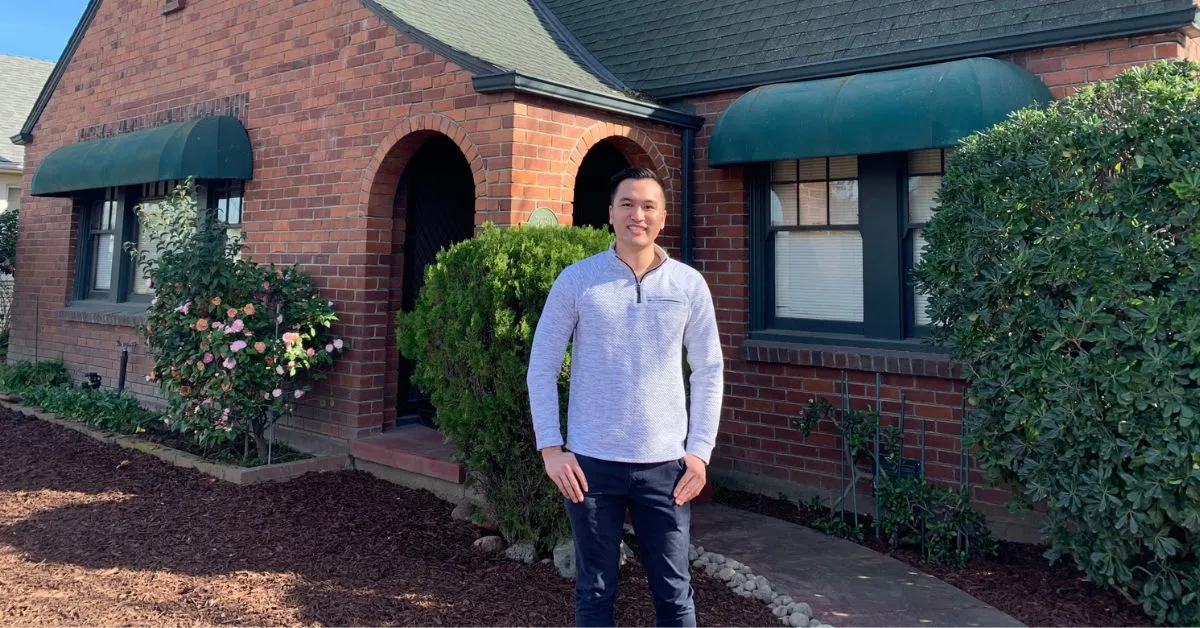
My first rental property set me back – but I’ve since rebuilt my portfolio. Here I am in front of one of my investment properties.
The rental property ROI formula every investor needs to know
Here’s the formula for calculating the ROI on your rental property:
ROI = (Rental Property Income – Expenses) ÷ Cost of Investment × 100
Let me break this down with an example:
Imagine you purchase a property for $100,000 with $10,000 in closing and renovation costs.
Your expenses run about $5,000 annually, and you earn $24,000 in yearly rental income.
Your calculation would look like this: ROI = (24,000 – 5,000) ÷ 110,000 × 100 = 17.27%
That’s a 17.27% return on your investment – significantly better than the average stock market return.
Note: You can also use a rental property ROI calculator like this one.
How I evaluate ROI for my properties (as a former pharmacist)
Most investors calculate ROI using best-case assumptions (stable rent, minimal vacancy, and smooth operating costs) without stress-testing the numbers when circumstances change.
Because small deviations in vacancy, maintenance, or turnover costs can materially change ROI over a year.
This is especially true for the strategy I use: rent-by-the-room student housing rentals. It can be an incredibly profitable and scalable strategy, but the numbers have to be correct.
That’s why I underwrite ROI the way I was trained to assess risk when I was working as a pharmacist: assume variability, account for side effects, and build in safety margins.
I model conservative vacancy, buffer operating expenses, and assume at least one non-routine cost per year. If the ROI still works under those assumptions, the deal is a winner.
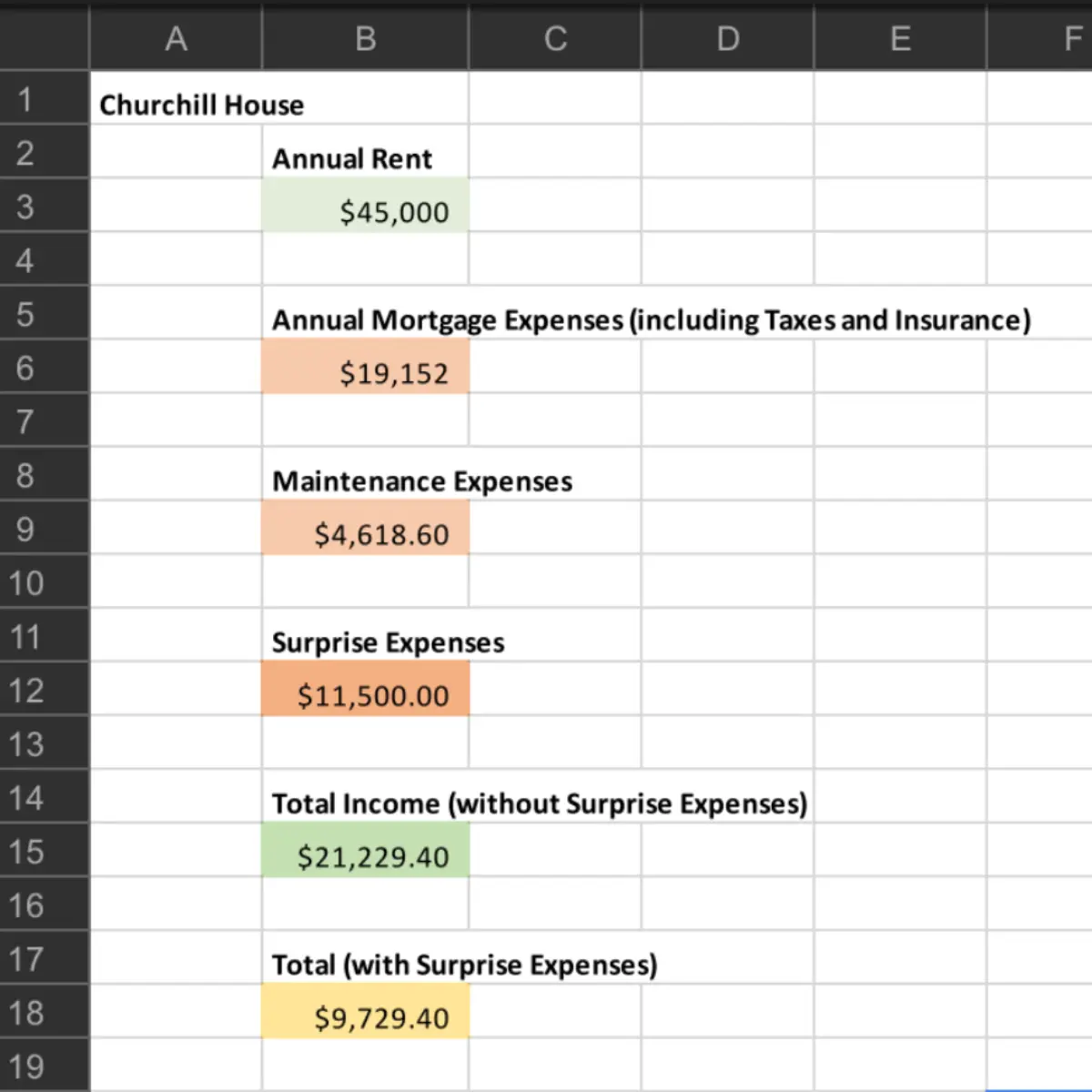
This is a simplified version of how I underwrite rental property ROI in Excel. I use conservative assumptions for rent, vacancy, and operating expenses before deciding whether a deal is worth pursuing. In this case, I had a surprise expense (I had to replace an HVAC), which goes to show how important it is to calculate ROI beforehand – and have a buffer.
How to calculate ROI on your rental property
When you buy a property outright with cash, your ROI calculation is relatively straightforward.
First, you need to know both your income and costs to calculate your ROI.
Net income:
This is your total rental income minus all expenses (repairs, property taxes, insurance, management fees, and so on).
Costs:
This includes the purchase price of the property, plus any closing costs, renovation expenses, and other upfront investments.
For example:
- Mortgage payment (but we’ll talk about calculating ROI with a mortgage in a later section)
- Taxes
- Home insurance
- Maintenance costs and repairs
- Property management fees
- Vacancies (missed income when the property is empty
- Utilities (if not paid by tenant)
- HOA fees (if applicable)
- Marketing costs
- Legal fees
- Landscaping
- Pest control
Let’s walk through a concrete example:
- You purchase a property for $100,000 cash
- You spend another $20,000 on repairs and closing costs
- Your total investment: $120,000
- After one year, your expenses total $3,000
- Your rental income is $1,000 monthly ($12,000 annually)
- Your annual return: $12,000 – $3,000 = $9,000
Using our formula:
ROI = Net Income ÷ Total Investment
ROI = $9,000 ÷ $120,000 = 0.075 × 100 = 7.5%
Rental property ROI calculator
Use this rental propety ROI calculator to calculate your ROI based on the above formula:
Now, let’s look at ROI on financed properties.
How to calculate ROI on your rental property with a mortgage
Here’s where real estate investing gets truly powerful – when you use financing to amplify your returns.
Let’s use the same $120,000 property but with a mortgage:
- You put down 20% ($24,000)
- Your closing costs and renovations are $16,000
- Total cash invested: $40,000
- Mortgage payments on $96,000 (at 6% for 30 years): $575.57 monthly ($6,907 annually)
- Other annual expenses: $3,000
- Annual rental income: $12,000
- Annual return: $12,000 – $9,907 = $2,093
ROI calculation: $2,093 ÷ $40,000 = 0.052325 × 100 = 5.2%
While this ROI is lower than our cash example, you’ve invested significantly less of your own money ($40,000 vs. $120,000). This allows you to purchase multiple properties and build your portfolio faster.
I talk more about analyzing a deal here:
Other ways to calculate ROI
While ROI gives you the big picture, these additional metrics provide deeper insights into your investment:
Annual cash flow
Formula: Rental income – expenses
This tells you how much actual money will hit your bank account each year. Positive cash flow means the property is putting money in your pocket monthly.
Gross rent multiplier (GRM)
Formula: Purchase price ÷ annual gross rental income
A lower GRM indicates better income potential relative to the property’s cost. This helps you quickly compare multiple properties.
Cash-on-cash return
Formula: (Annual pre-tax cash flow ÷ total cash investment) × 100
This shows how efficiently your invested dollars are working for you, especially important when using financing.
Net operating income
Formula: Total revenue – operating expenses
NOI reveals the property’s income-generating potential before financing costs. This is what professional investors focus on.
Cap rate
Formula: (Net operating income ÷ current market value) × 100
Cap rate helps you understand the relationship between a property’s income and its value, essential for comparing investments in different markets.
Factors that influence your property ROI
Based on my experience managing multiple properties, these factors have the biggest impact on your returns:
- Location: Perhaps the most critical factor, affecting everything from purchase price to rental rates and vacancy. I specifically target university areas for consistently high demand.
- Property type: Single-family homes typically deliver higher ROI than apartments or condos in most markets.
- Property condition: Well-maintained properties command higher rents and attract better tenants. Strategic renovations can dramatically boost ROI.
- Management strategy: Self-management saves money but costs time; professional management costs money but saves time. Your approach will impact your returns.
- Purchase price: The price you pay determines your baseline ROI. I’ve found that negotiation skills can add entire percentage points to your returns.
- Rental strategy: Room-by-room rentals (such as student rentals, which are my specialty) can increase income by 40-80% compared to whole-house rentals in the right markets.
- Interest rates: Even small changes in mortgage rates can significantly impact your ROI when using financing.
- Depreciation and tax benefits: Depreciation is the IRS-allowed tax deduction that lets you write off the cost of your building.
- Tax situation and structure: How you hold your properties (personal name, LLC, S-Corp) and your personal tax bracket can affect your after-tax returns. I’ve seen the same property deliver vastly different after-tax ROI to different investors based solely on tax planning.
How to maximize the ROI on your rental property
After building a portfolio that generates multiple six figures a year, I’ve developed a proven system for maximizing returns:
- Target undervalued markets with strong rental demand (university towns are my personal favorite)
- Buy properties with renovation potential where cosmetic improvements can substantially increase rental rates (however, beware of properties that require a lot of upfront investment)
- Implement strategic rent-by-the-room models when appropriate
- Develop systems for tenant screening to minimize vacancy and damage
- Create preventative maintenance schedules to avoid costly emergency repairs
- Utilize tax strategies specifically designed for real estate investors
- Refinance strategically to pull out equity and accelerate portfolio growth
- Self-manage your property by using “tenant empowerment”, which means that your tenants take on some of your task
What else should you know when buying your first property? Here you go:
Start building your profitable rental property portfolio today
Now you know exactly how to calculate ROI on rental properties and evaluate potential investments with confidence.
Remember: I started exactly where you are now – uncertain, making costly mistakes, and learning painful lessons. But by applying these principles consistently, I’ve built a rental portfolio that generates multiple six figures annually.
I now help new real estate investors identify profitable properties, negotiate better deals, find quality tenants, and create automated systems that maximize returns while minimizing headaches.
Ready to start building your own profitable real estate portfolio? Check out my real estate mentorship here.
Read more: