Most people think you need six figures in the bank to buy your first rental property.
You don’t.
But you do need a realistic understanding of the numbers — because underestimating your upfront costs is one of the fastest ways to derail your first deal.
I learned that lesson early on. On my first property, unexpected expenses showed up fast, and for a moment, it felt like the whole deal might fall apart.
Fixing those mistakes and learning how to budget conservatively became the foundation of my entire real estate portfolio and eventually allowed me to retire at 31.
In this guide, I’ll break down exactly how much money you really need to buy your first rental property, using simple math and a real $300,000 example. I’ll also show how different strategies, like house hacking versus buying a traditional rental, can dramatically change how much cash you need upfront.
Read on!
TL;DR: How much money do you need to buy your first rental property?
If you’re looking at a $300,000 rental property, most first-time investors will need around $60,000–$85,000 for a traditional, non-owner-occupied deal.
That number depends heavily on strategy.
Here’s the quick breakdown:
- Down payment
- 3–5% if you house hack (owner-occupied)
- 15–25% for a traditional investment property
- Closing costs: ~2–5% of the loan amount
- Renovations & repairs: typically $5,000–$20,000+
- Furnishings (if renting by the room): ~$3,000–$8,000
- Reserves: 3–6 months of expenses (or ~$300/month set aside for long-term repairs)
Using strategies like house hacking, that upfront cash requirement can drop significantly (sometimes to $30,000 or less) while still keeping your risk manageable.
In the rest of this guide, I’ll walk you through each of these costs step by step, explain where beginners usually underestimate expenses, and show you how to budget conservatively so your first rental doesn’t turn into a financial stress test.
Prefer video?
If you want a quick walkthrough of how these numbers work in real life, here’s a short video where I break it down step by step:

Hi! I’m Ryan Chaw. I’m a pharmacist-turned–real estate investor who built a multi–six-figure rental portfolio by starting with house hacking and student rentals. I now help new investors buy their first profitable rental property without overextending themselves. Read more about me here!
What impacts how much money you need?
Before we get into specific numbers, it helps to understand why two people can buy similar properties and need very different amounts of money.
I think about this using what I call the Real Estate Wealth Triangle. It has three sides:
- Time: how early (or late) you start
- Money: your cash, credit score, and income
- Strategy: how you invest (house hacking, rent-by-the-room, traditional rentals, and more)
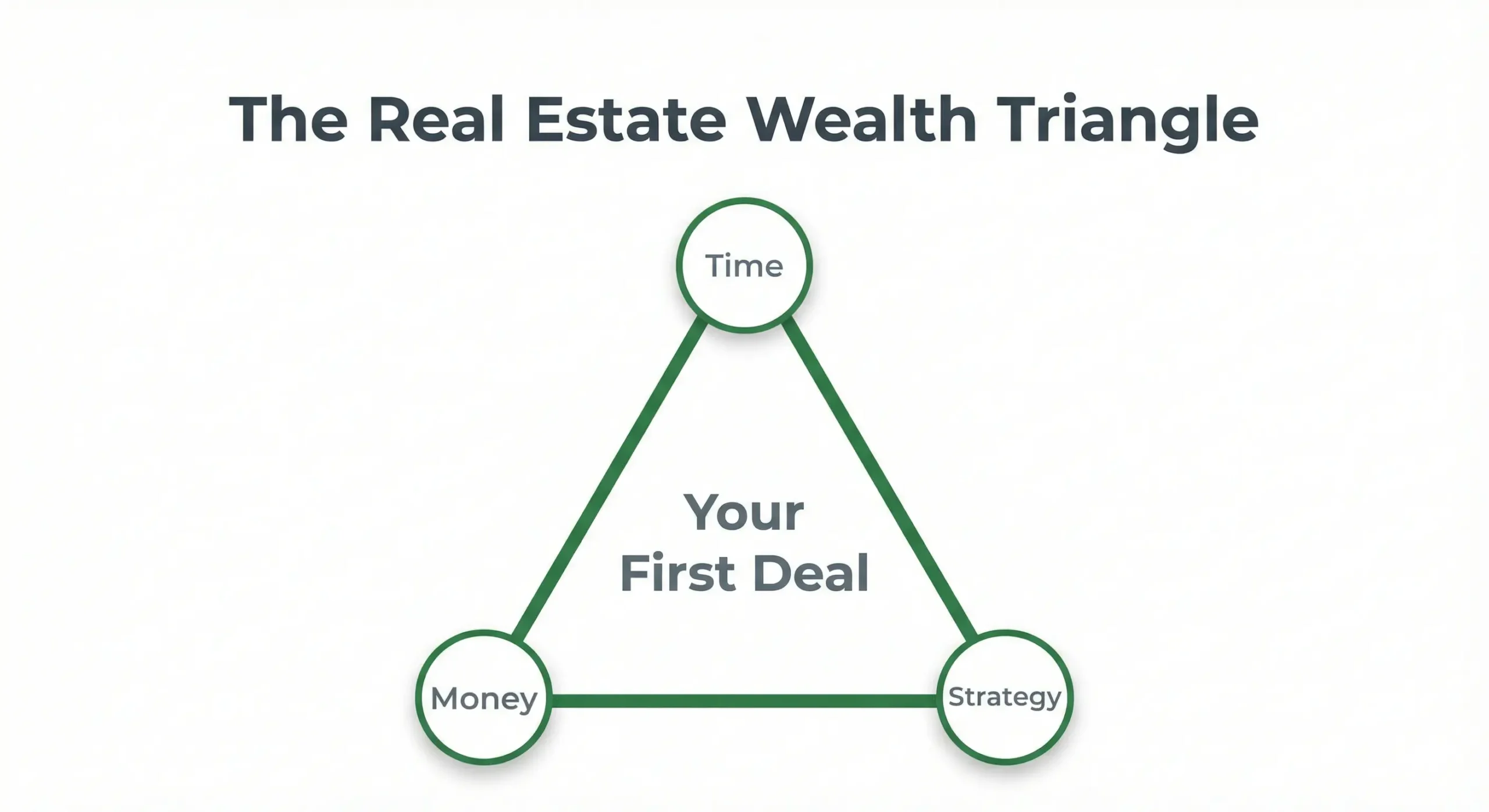
You can’t optimize all three at once. But when you’re just getting started, strategy is the lever that matters most.
That’s why there’s no single “right” number for how much money you need. A traditional rental might require a large down payment and reserves. A house hack or rent-by-the-room property can dramatically lower how much cash you need upfront — without increasing risk if you run the numbers conservatively.
Once you understand that, the rest of the math starts to make sense.
Money: the numbers that matter
Even though strategy can reduce how much cash you need, the money side of the equation still matters.
The first factor is purchase price. A $200,000 rental might require $40,000–$60,000 all-in, while a $400,000 property can easily push that number past $100,000. Higher prices mean larger down payments, higher closing costs, and bigger reserves.
Next is loan type and credit score. Owner-occupied loans can require as little as 3–5% down, while non-owner-occupied investment loans typically require 15–25% down. Most conventional loans look for credit scores around 680+, with better terms above 720. FHA loans can often go lower. Read more about financing options here.
Finally, your local market and experience level matter. Lower-priced markets often require more repairs. Higher-priced markets may be more turnkey but demand more cash upfront. As you gain experience, additional financing options may open up — but early on, conservative assumptions matter more than flexibility.
Strategy is where you win early
This is where I personally changed the game.
When I started, I didn’t have unlimited cash. What I did have was the willingness to use strategies that reduced my upfront risk, especially house hacking and rent-by-the-room.
A traditional single-family rental often requires more cash and stronger cash flow from day one.
When I started house hacking, my tenants covered the entire mortgage. That meant my housing cost dropped dramatically while I gained experience as a landlord.
Here’s a short video where I explain how house hacking works — and why it can dramatically reduce how much cash you need upfront:
That’s the key idea here: the right strategy doesn’t eliminate risk but it does change it. And for beginners, changing risk usually means lowering how much money you need upfront while keeping strong reserves.
If you want more strategies, check out my guide with the most profitable rental property types.
The 6 buckets you need to budget for
Most first-time investors don’t get burned because they bought the wrong house.
They get burned because they run out of cash.
I’ve seen this over and over — and I lived it myself. On my first deal, I thought I was fine because I had the down payment saved. Then an unexpected repair showed up, and suddenly I was scrambling to cover costs I hadn’t planned for.
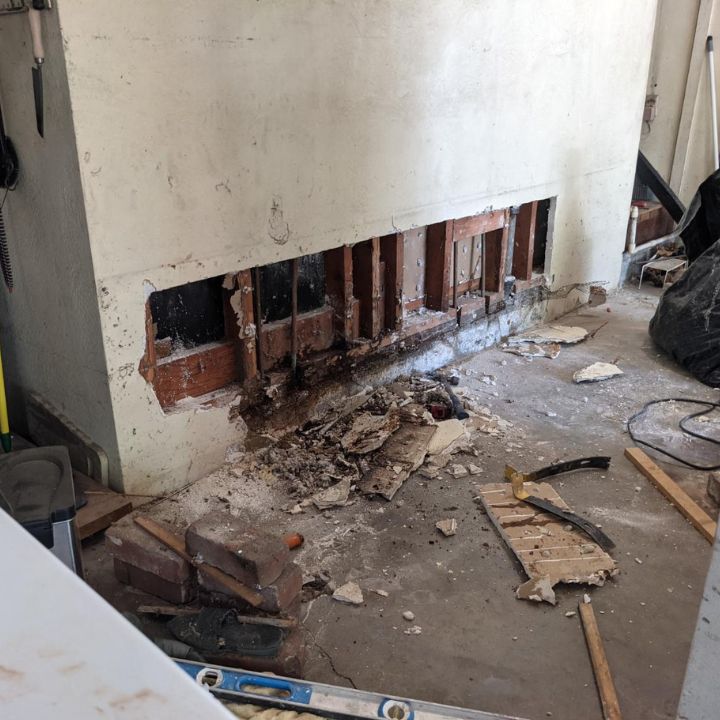
I ended up with $30,000 in unplanned expenses…and it nearly cost me my real estate business.
That’s why I teach beginners to budget using six simple buckets. If you account for all six before you buy, there are far fewer surprises at closing — or in your first few months of ownership.
- Down payment
- Closing costs
- Renovations
- Repairs and capital expenditures
- Furnishings (if you’re renting by the room or furnishing a unit)
- Reserves
In the next sections, I’ll walk you through each bucket step-by-step with real numbers (including a $300,000 example), plus how I personally budget for these on my own rentals, so you know exactly what to expect before you buy.
Bucket 1: Down payment
Your down payment is usually the biggest upfront cost, so this is where most people get stuck, or give up before they even start.
Here are the general rules of thumb:
- House hack (owner-occupied): 3–5% down
- Non-owner-occupied investment property: 15–25% down
- DSCR loans: 20–25% down, but more flexible on income requirements
Let’s put real numbers to this.
If you’re buying a $300,000 property:
- 20% down = $60,000
- 3% down = $9,000
That one strategy change can be the difference between needing sixty grand… or under ten.
This is why house hacking is such a powerful option for first-time investors. House hacking simply means you live in the property and rent out the other rooms or units.
I’ve done this myself. I lived in the master bedroom of one of my properties in Sacramento and rented out the other bedrooms for about $800–$850 per month each. Those rents covered the entire mortgage, so I essentially lived rent-free in California and generated cash flow.
You can use my house hacking calculator here to see how much you need saved up!
Now, it’s not for everyone. You’ll be living with roommates, so if you have a family or value privacy above all else, buying a separate investment property might make more sense. But if your goal is to get started with the least amount of cash possible, house hacking is hard to beat.
Bucket 2: Closing costs
Closing costs are one of the most common (and most expensive) surprises for first-time investors.
A lot of people save up just enough for the down payment and think they’re ready. Then they get their closing disclosure and realize they’re short thousands of dollars. I’ve seen deals fall apart at the finish line because of this.
Closing costs include all the fees you pay to actually close the deal: things like lender fees, appraisal, title and escrow fees, recording fees, and prepaid taxes and insurance.
As a rule of thumb, closing costs usually run about 2–5% of the loan amount.
So if you’re buying a $300,000 property and putting 20% down, your loan is $240,000. Five percent of that is $12,000—and that’s money you need on top of your down payment.
The good news is you don’t always have to pay all of this out of pocket.
On many of my deals, I negotiate for the seller to cover part—or even all—of my closing costs. This often comes up after inspections, when the seller would rather offer a credit than make repairs themselves. With the right offer and a good agent, you can save yourself thousands of dollars here.
The key is simple: budget for closing costs first, then work on reducing them through smart negotiation.
Bucket 3: Renovations
Renovations are where deals can either improve — or quietly blow your budget.
When I evaluate renovations, I’m not trying to make a property perfect. I’m asking one question: Will this actually increase rent or reduce risk? If the answer is no, it’s usually optional.
For most first-time investors, renovation budgets should stay focused on simple, value-driven updates:
- Adding bedrooms
- New flooring (I usually use luxury vinyl plank)
- Paint, lighting, and basic cosmetic updates
To give you real numbers, adding a bedroom typically costs around $1,500–$2,500 per room, depending on the layout and local labor costs. New flooring with luxury vinyl plank usually runs about $4–$6 per square foot.
Here’s why this matters:
When I rent by the room, every additional bedroom can add $600–$800 per month in rent. Spending a few thousand dollars upfront to add a bedroom can dramatically increase your monthly cash flow and pay for itself quickly.
Bucket 4: Repairs and capital expenditures
Repairs and capital expenditures are what turn a “good deal on paper” into a stressful one if you ignore them.
Every property will eventually need big-ticket items like a roof, HVAC system, water heater, or plumbing work. The goal isn’t to avoid these costs — it’s to plan for them before they become emergencies.
That’s why inspections and conservative reserves matter so much on your first deal.
Once I have a property under contract, I don’t just do a basic home inspection. I often add plumbing, roof, HVAC, or electrical inspections if anything looks questionable.
Then I’ll have a general contractor walk the property and estimate what it would cost to fix or replace those items, whether that’s now or in the next few years.
Bucket 5: Furnishings
Furnishings are easy to overlook — until you need them before you can rent the property.
If you’re house hacking or renting by the room, furnishings are part of the upfront cost and need to be budgeted just like everything else. The goal isn’t luxury. It’s clean, durable, and functional so you can rent quickly and reduce vacancy risk.
In my experience, furnishing a rent-by-the-room property typically costs around $3,000–$8,000, depending on the size of the house and how many rooms you’re furnishing. That includes beds, desks, dressers, couches, and basic kitchen and common-area items.
Bucket 6: Reserves
Reserves are the most important bucket, and the one most beginners underestimate.
Reserves are simply the cash you keep set aside after you close, so one unexpected issue doesn’t wipe you out. Vacancies, repairs, higher utility bills, or a delayed tenant move-in all happen in real life, even on good deals.
As a rule of thumb, I recommend keeping 3–6 months of expenses in reserves for each property. If that feels overwhelming, another simple guideline is to set aside at least $300 per month per property specifically for long-term repairs and capital expenditures.
This isn’t money you hope to spend. It’s money that buys you peace of mind.
On my own rentals, reserves are what allow me to sleep at night. When a water heater fails or a tenant moves out unexpectedly, it’s an inconvenience—not a crisis—because the money is already there.
If there’s one place not to cut corners, it’s reserves. Strong reserves turn real estate from a stressful side hustle into a sustainable, long-term wealth-building strategy.
Putting it all together: Full cost breakdown for a $300,000 rental property
Now that you’ve seen how each bucket works, let’s put real numbers behind everything so you can see what this looks like in practice.
The formula behind it is simple:
Total cash needed = Down payment + closing costs + renovations + repairs + furnishings + reserves
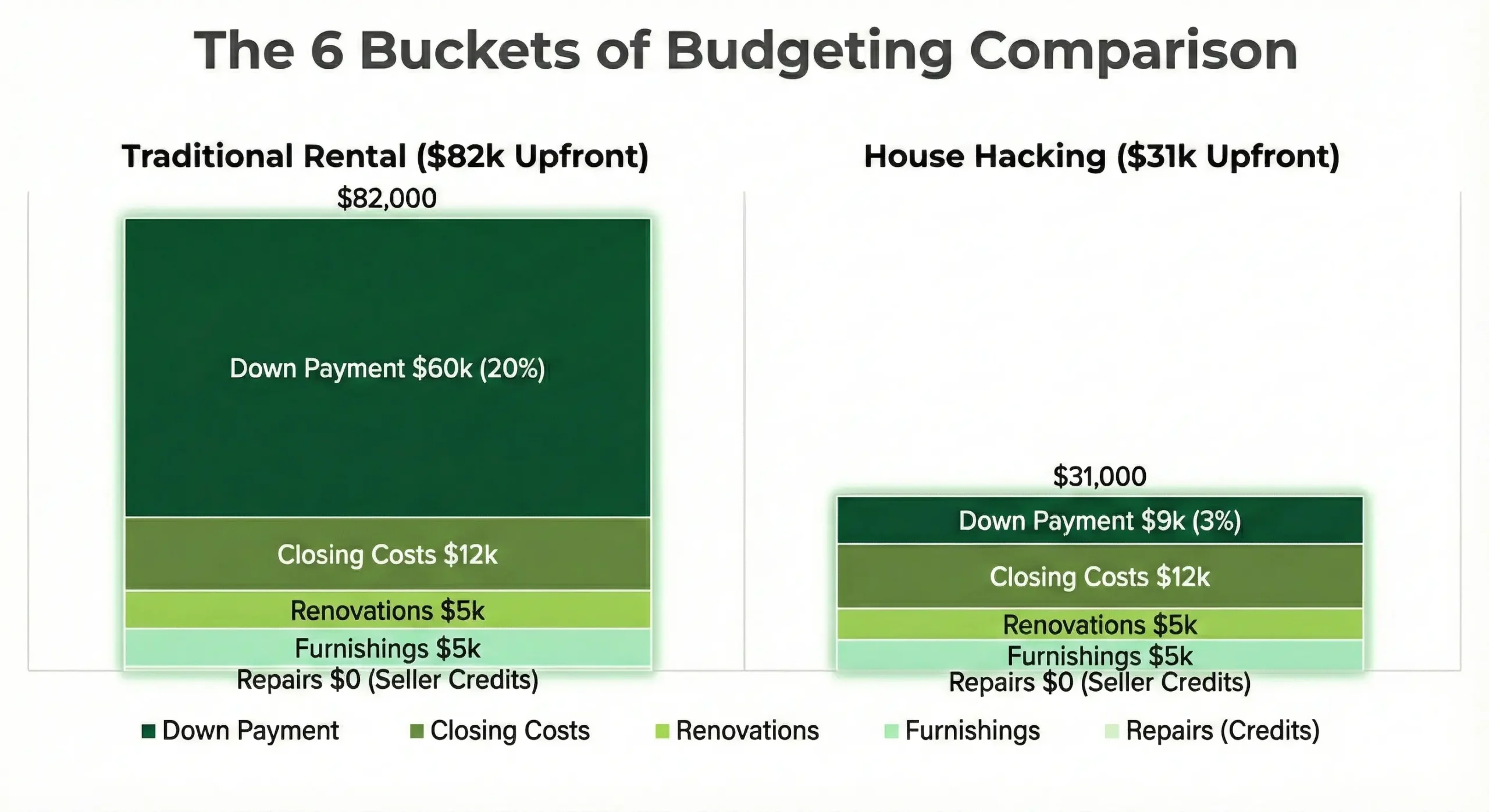
Example #1: 20% down, non-owner-occupied rental
Let’s say you’re buying a $300,000 rental property as a traditional investment (you’re not living in it).
Here’s how the math breaks down:
- Purchase price: $300,000
- Down payment (20%): $60,000
- Loan amount: $240,000
- Closing costs (5% of loan): ~$12,000
- Renovations (adding 2 bedrooms): ~$5,000
- Furnishings: ~$5,000
- Repairs: $0 (negotiated as seller credits after inspection)
That puts your total all-in cash needed at roughly $82,000. In my experience, you should typically have $60,000-$80,000 saved up.
Want to see what this looks like in real life?
Here’s a short breakdown of how Yuzo structured his first deal — including how much cash he invested and how the numbers actually worked:
How house hacking changes the math
If you don’t have $60,000-$80,000 saved up, you can use house hacking.
Instead of putting 20% down on the same $300,000 property, you use an owner-occupied loan:
- Purchase price: $300,000
- Down payment (3%): $9,000
- Loan amount: $240,000
- Closing costs (5% of loan): ~$12,000
- Renovations (adding 2 bedrooms): ~$5,000
- Furnishings: ~$5,000
- Repairs: $0 (negotiated as seller credits after inspection)
Your total cash needed drops dramatically compared to the $82,000 example above and you only need $31,000.
On top of that, your tenants can cover the entire mortgage while you live in the property. That’s exactly how I learned real estate, living in the property, letting tenants pay the bills, and gaining experience without bleeding cash.
How much money do you need based on strategy?
| Strategy | Typical down payment | Extra costs | Best for |
| House hack | 3–5% | Medium (furnishings) | Beginners with lower savings who don’t mind living with roommates and who want maximum cash flow |
| Student housing / rent-by-the-room | 20–25% | Higher furnishings | Investors focused on maximum cash flow |
| Short-term rentals | 15–25% | High furnishings and CapEx | Advanced investors with a hospitality mindset |
How to choose the right strategy
This ties directly back to the Real Estate Wealth Triangle I explained in the beginning: time, money, and strategy.
- If you have less cash but a higher tolerance for roommates, house hacking is one of the fastest ways to get started.
- If your goal is maximum cash flow and you’re near a strong college market, student housing can be incredibly powerful.
Both house hacking and rent-by-the-room/student housing use the same principle: to maximize rentals by using every room to generate cash flow.
What if you don’t have enough money yet?
If you’re reading this and thinking, “I get it, but I’m not there yet,” that’s normal. Most people don’t start with a perfect financial situation. I didn’t either. What matters is having a plan:
How to shrink the money you need
The fastest way to get started isn’t always saving more, but to needing less upfront.
First, house hack if you can. We’ve already talked about this, but it’s worth repeating: living in the property and renting out the other rooms dramatically reduces your down payment and monthly risk. That’s how I got started.
Second, look at lower-cost markets close to you. As a beginner, you should invest somewhere close to you – and if you live close to such an area, cheaper markets often mean smaller down payments and lower reserves.
(However, remember I got started in California! Not all factors have to be perfectly aligned.)
Third, focus on cosmetic fixes, not structural projects. Paint, flooring, and light updates are manageable. Major foundation, roof, or sewer issues can drain cash fast.
Finally, negotiate seller credits aggressively. I’ve had sellers cover repairs and closing costs simply because I asked—especially after inspections.
How to increase the money you have
When I was getting started, I didn’t try to optimize everything. I focused on one clear goal: saving enough for my first rental.
For most beginners, that means keeping it simple and time-bound. Cut the biggest expenses first, like housing and car payments. Lifestyle upgrades can wait. Small daily savings matter far less than controlling your largest costs.
Just as important, set a specific savings target and a real deadline. “Someday” doesn’t build momentum. A number and a date do. When you know exactly what you’re saving for, it’s much easier to stay focused for 12–24 months and put yourself in a position to buy your first property confidently.
Build a 12–24 month plan to buy your first rental
Here’s a simple framework I recommend to beginners:
- Months 1–3: Learn the basics and pick a strategy that fits your budget and lifestyle.
- Months 4–12: Save aggressively, improve your credit, and build your team—agent, lender, inspector, and contractor. Something that will help you get ahead is to find a mentor.
- Months 12–24: Analyze deals, write offers, and close on your first rental property.
FAQs: Real questions new investors ask about saving for and financing a rental property
Below are the questions I get all the time from people saving for and financing their first rental property. I’ll keep the answers clear, practical, and based on what I’ve actually seen work.
How much money do I need to buy my first rental property?
For most first-time investors, the realistic range is $60,000–$85,000 for a traditional $300,000 rental. That includes your down payment, closing costs, light renovations, furnishings (if needed), and reserves. If you use strategies like house hacking, that number can be much lower.
Can I buy a rental property with only $10k–$20k saved?
Yes, but strategy matters. With $10k–$20k, your best option is usually a house hack using an owner-occupied loan with a low down payment. You won’t have much margin for error, so conservative numbers and strong reserves are critical.
What’s the minimum down payment for an investment property?
For non-owner-occupied rentals, expect 15–25% down. If you’re living in the property, owner-occupied loans can require as little as 3–5% down. The lower the down payment, the more important cash flow and reserves become.
How much should I save for repairs and big-ticket items?
I recommend budgeting for 3–6 months of expenses in reserves. Another simple rule I use is setting aside about $300 per month per property for long-term repairs like roofs, HVAC systems, and plumbing. That way, big expenses don’t become emergencies.
Is house hacking really cheaper than renting?
In many cases, yes. When done correctly, house hacking can allow your tenants to cover the mortgage, which means your housing cost drops dramatically, sometimes to zero. That’s why it’s one of my favorite ways for beginners to get started.
Do I need six figures of income to invest in real estate?
No. What matters more than income is strategy, credit, and cash management. I’ve seen people with average incomes buy rentals successfully by starting small, using owner-occupied loans, and focusing on cash-flowing properties.
How much cash flow should I aim for on my first rental?
Early on, I care more about learning and stability than maximizing cash flow. If your first deal breaks even or cash flows modestly and you’re living for free through house hacking, that’s a win. Strong reserves matter more than squeezing every dollar out.
Is it better to wait for lower interest rates or buy now?
Trying to time the market usually backfires. What matters more is buying a deal that makes sense with today’s numbers. Interest rates change, but good properties, strong cash flow, and time in the market are what actually build wealth.
Is purchasing a rental property worth it?
Yes, if the numbers make sense. Rental properties are worth it when they provide cash flow, long-term appreciation, and don’t stretch you financially. I didn’t start to get rich fast, I started to lower my housing costs and build wealth over time. Bought conservatively, with strong reserves, rentals can be a reliable long-term investment.
Final thoughts. You probably need less money than you think – if you use the right strategy
Most people don’t struggle with real estate because they lack money. They struggle because they underestimate costs, choose the wrong strategy, or move forward without a conservative plan.
You don’t need perfection to get started. You need clear numbers, solid reserves, and a strategy that fits your situation. That’s how I approached my first deal — lowering my housing costs first, managing risk carefully, and building from there one property at a time.
If you want help applying this to your own situation — choosing the right strategy, sanity-checking your numbers, and avoiding the mistakes that cost beginners tens of thousands of dollars — that’s where guidance can make a difference.
I work with new investors to help them buy their first profitable house hack or student rental step by step, using conservative assumptions and real-world numbers. If that sounds useful, you can learn more about my real estate investing coaching here.
Read more about my real estate investing coaching here!
Read more: